
Checking Criminal History in Grand Junction
Grand Junction criminal records begin with the office that created them. The Grand Junction Police Department holds its own incident, crash, body-camera, and emergency-call material. Grand Junction Municipal Court holds ordinance and municipal traffic or criminal case records. A custodial arrest moves to the Mesa County Detention Facility, and a state-law prosecution moves to the District or County Court clerk at the Mesa County Justice Center. CBI’s Colorado history product is the last layer, not a substitute for the local files.
- Identify whether GJPD, another police agency, or the sheriff handled the event.
- Ask GJPD Records and Data Management for the city report and specify the right recording or document.
- Read the citation or case notice to determine whether Municipal Court or Mesa County Combined Court owns the case.
- Check the county booking report or inmate locator for a custodial arrest.
- Use CBI Internet Criminal History Check for a Colorado-wide self-review, and use fingerprints when identity certainty matters.
Keep each identifier with its custodian. One event may have a GJPD incident number, a Mesa booking number, and a court case number. Supplying the wrong number can slow a search even when the name is correct.
Grand Junction Paperless Police Records
GJPD says its Records and Data Management Unit is paperless and staffed by eight master-certified records specialists. That local setup matters because a request is not simply a search through file cabinets. Staff locate digital reports and media, review the request, apply Colorado disclosure rules, and redact protected content. The official GJPD records overview shows the unit’s role and available record channels.
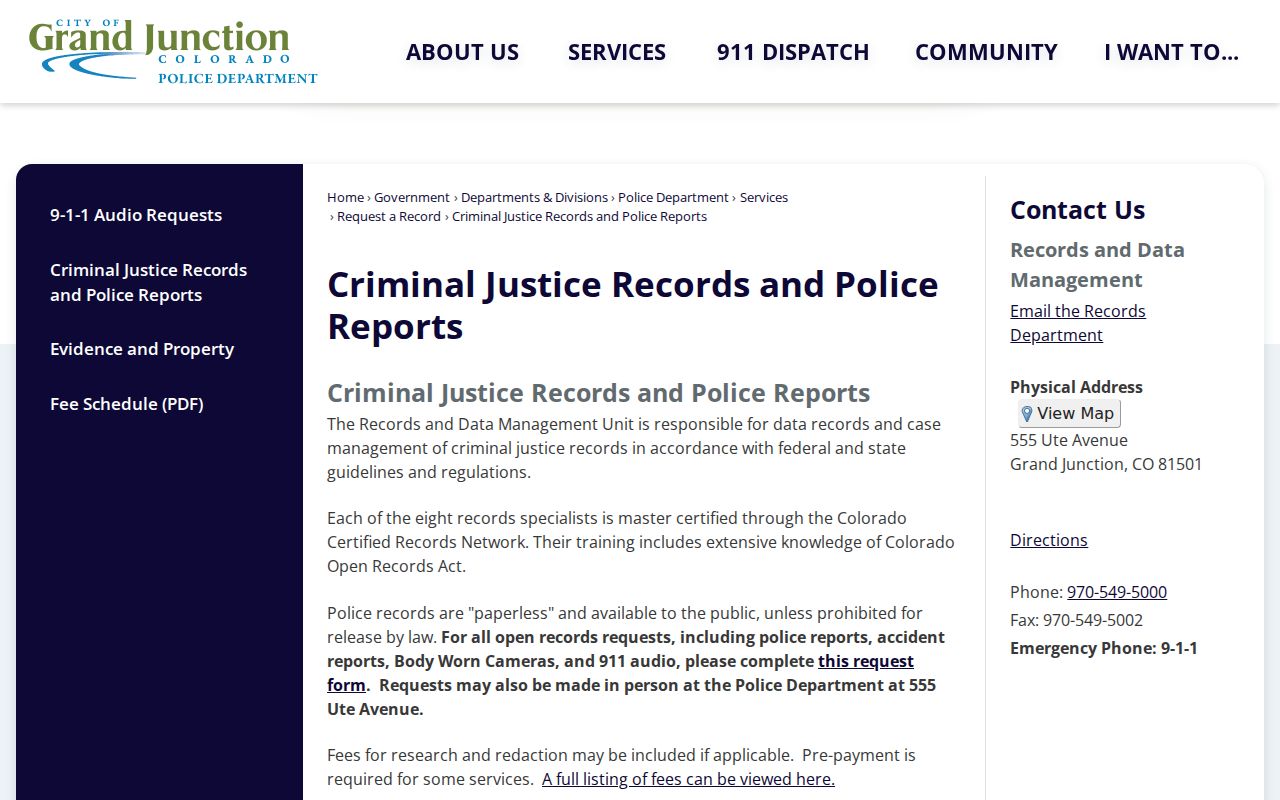
The image reflects the city’s direct route for police-created records. It also reinforces why a county clerk search cannot produce a body-camera file or GJPD incident narrative.
Paperless does not mean instant or wholly public. Voices, screens, medical scenes, juveniles, addresses, witnesses, and uninvolved people may require review or redaction. Ask for a cost estimate and narrow the date, place, incident number, and exact media sought.
Grand Junction Police Department Records
Records and Data Management operates at 555 Ute Avenue, Grand Junction, CO 81501. The lobby is open from 7 a.m. to 5 p.m. on weekdays. Call 970-549-5000 or fax 970-549-5002. The unit handles city police reports and related media, but not court pleadings, Mesa County Sheriff reports, or records made by Colorado State Patrol.
The city’s request-a-record instructions organize the request around contact and delivery details, incident date, time and place, involved parties, the police case number when known, and the exact product sought. Those products can include a report, accident record, 911 audio, or body-camera recording.
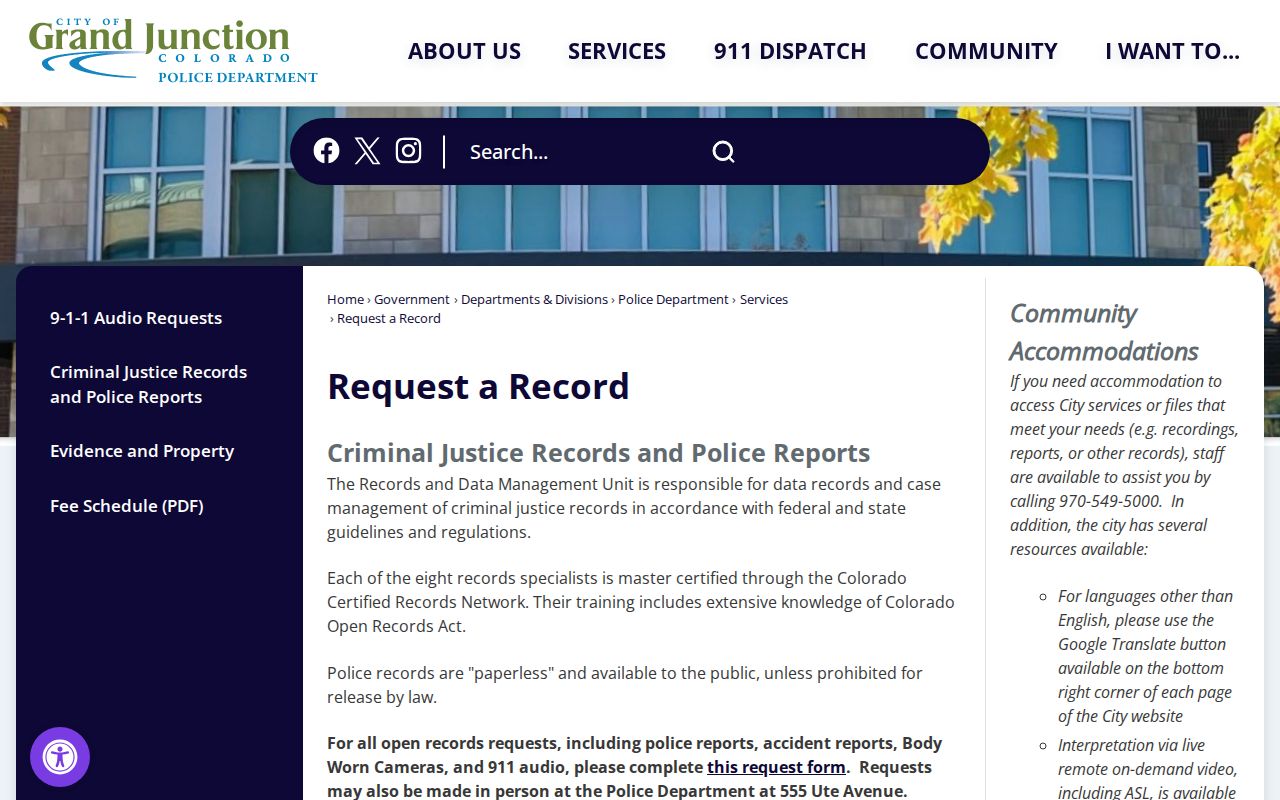
This request view is the practical starting point for a GJPD file. A focused description gives records staff a better basis for search, review, and a fee estimate.
GJPD Records and Data Management
555 Ute Avenue
Grand Junction, CO 81501
970-549-5000
Weekdays, 7 a.m.–5 p.m.
Grand Junction Police Record Fees
Grand Junction publishes unusually specific price information. A request begins with a $6 nonrefundable processing fee. The city may require a deposit or prepayment when the work will cost more. A disc is $6. Photocopies cost $1 for up to four pages, then $0.25 per page. Search or redaction beyond the first hour costs $5 per quarter-hour. These are GJPD terms, not a universal fee schedule for every Mesa County custodian.
| GJPD item | Published amount |
|---|---|
| Base processing | $6, nonrefundable |
| Disc | $6 each |
| Photocopies | $1 through four pages, then $0.25 per page |
| Search or redaction over one hour | $5 per quarter-hour |
The city’s evidence and property fee page is the source for these details.
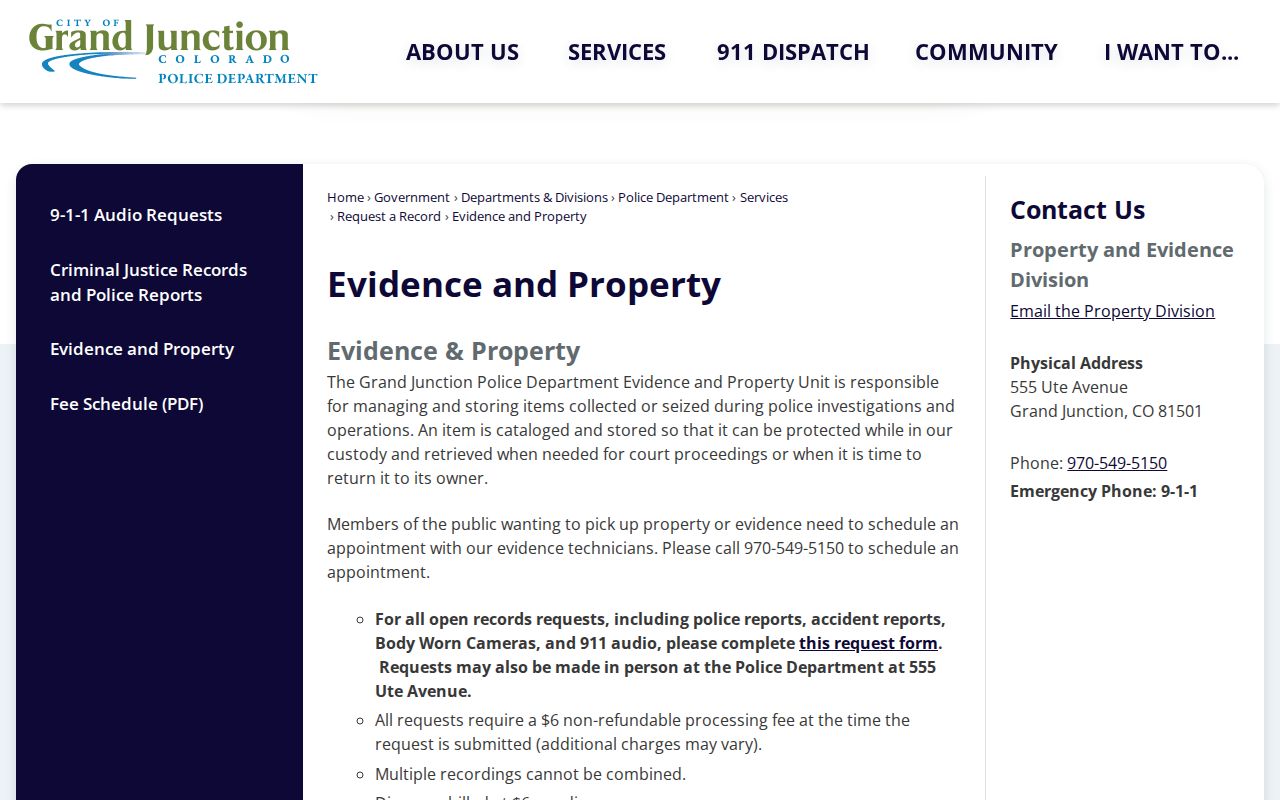
The fee display helps a requester choose a tight scope before staff begin extensive review. Payment does not guarantee release of material that law permits the custodian to withhold.
Grand Junction Arrests and Bookings
GJPD does not operate the county booking archive. People taken into custody in Grand Junction are booked at the Mesa County Detention Facility at 215 Rice Street. The official Booking Summary Report covers the preceding 24 hours and an archive period. The inmate locator searches by last name, date of birth, or booking number. These county tools answer booking and custody questions, while GJPD supplies the city incident or arrest report.
A useful sequence is booking report, inmate locator, GJPD report, then the correct court. The booking charge is preliminary. Prosecutors may decline, amend, or replace it, and only the court file shows the formal charge and disposition. For a deeper county custody explanation, use the Mesa County Arrest Lookup.
Grand Junction Arrests Reach Rice Street
A GJPD custodial arrest leaves a trail in more than one system. Officers create the city report. Mesa County detention staff create the booking file. A prosecutor may then file a municipal or state case. Later, reportable fingerprints and the court disposition can become part of the Colorado Bureau of Investigation record.
Local flow: GJPD incident › Mesa County booking › municipal or county prosecution › CBI history
Timing differs at every point. A fresh booking may appear before any case is filed. A police report may remain restricted during an active investigation. A completed court case can contain a disposition that is not yet matched to the state arrest cycle. Compare identifiers and dates before concluding that a record is missing.
Municipal Court Records in Grand Junction
Grand Junction Municipal Court handles violations of the city code and municipal traffic or criminal matters. It does not become the record holder merely because a GJPD officer was involved. Citations from Colorado State Patrol or Mesa County Sheriff generally route to Mesa County Court, and a state-law charge may be filed at 125 North Spruce Street.
The Grand Junction Municipal Court page lists court services and docket links. Court services generally run Monday through Thursday from 7 a.m. to 4 p.m., with early service reserved for juveniles. Call 970-244-1537 for current clerk guidance.
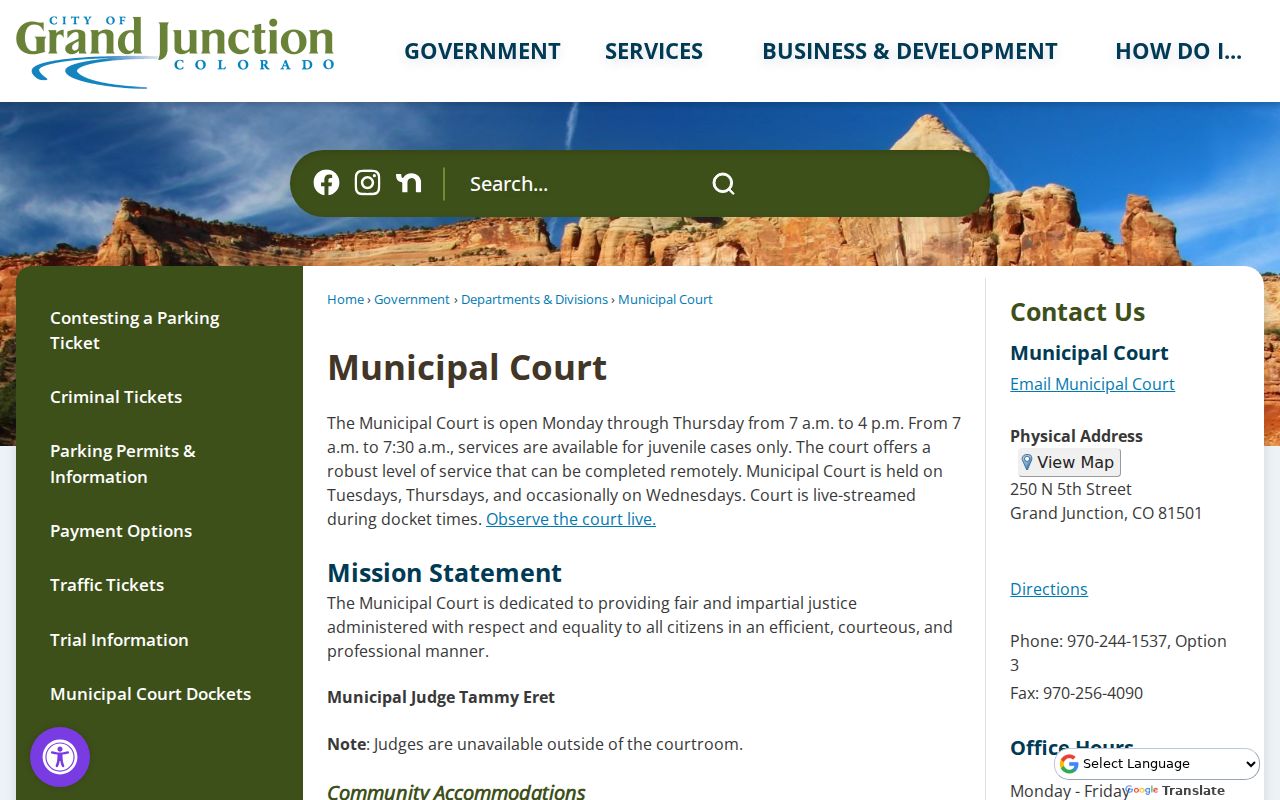
The online court view aids scheduling and public observation, but it is not a certified archive. Request the docket record and specific orders from the clerk for a completed municipal case.
| Court | Grand Junction Municipal Court |
|---|---|
| Case scope | City-code and municipal traffic or criminal matters |
| Lookup route | Published docket links, livestream, clerk contact |
| File contents | Case number, allegations, settings, pleas, orders, result, and financial entries as applicable |
| Copies | Request the docket record or named orders from the municipal clerk |
Grand Junction Municipal Docket Livestream
The municipal docket livestream is a public-observation aid. It can help someone follow a scheduled proceeding without treating a video feed as a case database. It does not replace the clerk’s register, a written order, or a certified copy. A reader researching an older Grand Junction criminal record should give the clerk the case number, party name, and approximate year.
Failure to appear can lead to a warrant, and a missed traffic setting may carry licensing effects. If a warrant concern arises, contact the issuing court to confirm the case number and ask about appearance, bond, or recall procedure. Do not rely on an old calendar or assume that making a payment has already cleared every law-enforcement system.
Where Grand Junction Records Go
City reports stay with GJPD, but a Grand Junction case can move beyond city custody. Municipal code matters remain with the municipal clerk. Felony, misdemeanor, and other state-law filings are kept by the 21st Judicial District’s District and County Court clerk. CBI builds statewide history from fingerprint-supported arrest cycles and later disposition reports.
Record flow: Grand Junction PD › Mesa County Courts › Colorado Bureau of Investigation
That line is a routing map, not proof that every file contains the same facts. The police report describes the incident. The booking entry records custody. The court register tracks filed charges and the outcome. CBI presents Colorado arrest and disposition history subject to its public-access limits. The broader Mesa County criminal history overview explains how these layers compare.
Grand Junction 911 Record Requests
Ask for 911 audio or body-camera footage by naming the incident, date, place, involved party, and format. GJPD gives two-week guidance for some evidence and recording processing, but that is not a universal deadline under the Colorado Criminal Justice Records Act. A broad request can take more review because one clip may reveal many protected details.
The city states that multiple recordings cannot be combined. That means a request involving several officers or calls may produce separate items, separate review work, and added cost. The official records channel listed in the research inventory illustrates the same police-record route.
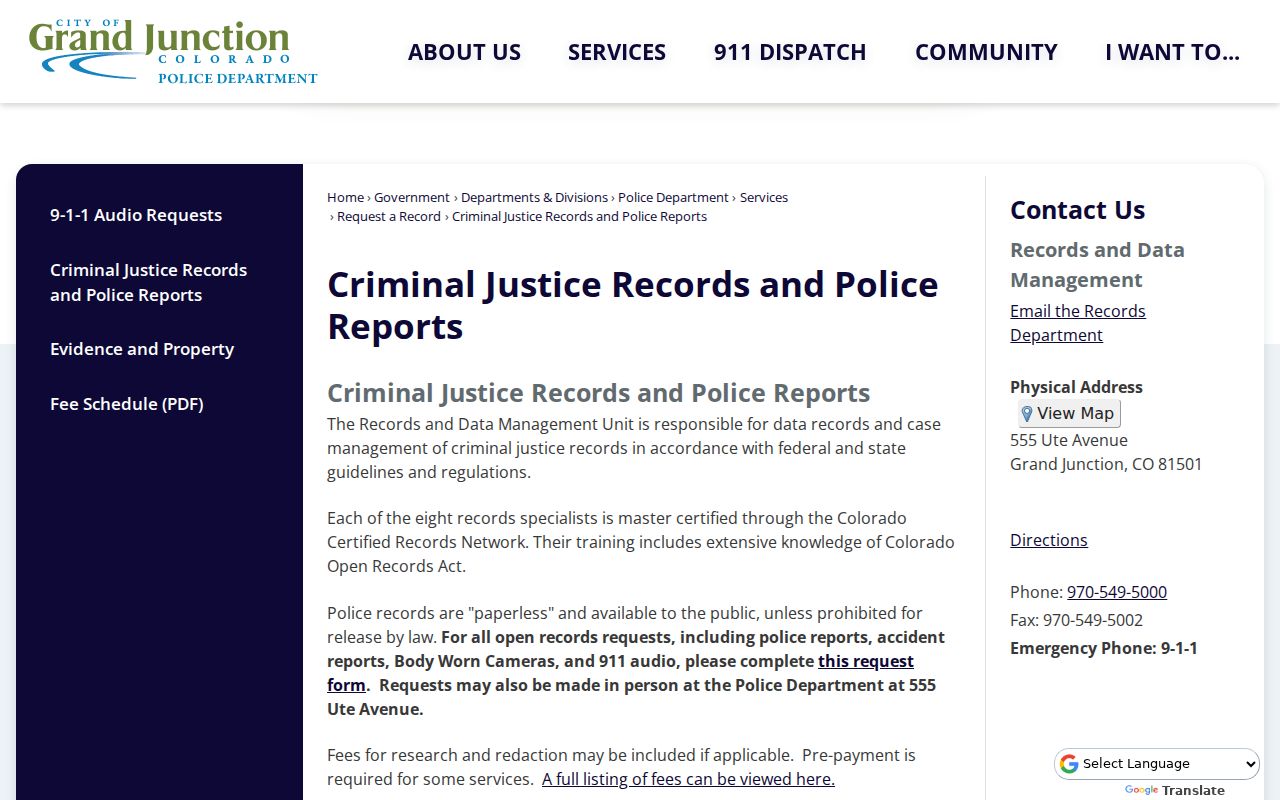
The displayed channel helps frame a media request precisely. Ask what can be released in redacted form if the full recording is withheld.
Grand Junction City or County Records
The badge on the officer’s uniform does not always identify the court. A GJPD report stays at 555 Ute Avenue, but a state charge belongs at the Mesa County Justice Center. A city-code case belongs with Municipal Court. A custodial entry belongs with detention staff at Rice Street.
- Incident number
- The GJPD identifier for the police event and report.
- Booking number
- The Mesa County detention identifier created after custodial intake.
- Municipal case number
- The identifier for a Grand Junction ordinance prosecution.
- State court case number
- The District or County Court identifier for charges filed under Colorado law.
Read the citation’s agency, court location, date, and appearance line. Those details prevent a trip to the wrong counter and help the correct clerk find Grand Junction criminal records without a broad name-only search.
Public Access Rules in Grand Junction
Colorado law separates criminal-justice records from ordinary city records. Police incident material generally falls under the Colorado Criminal Justice Records Act, which permits custodian review and can protect active investigations, juveniles, victims, witnesses, medical facts, and personal identifiers. Municipal court access also follows court rules and the clerk’s procedures. Ask for a written explanation and a redacted version if full access is denied.
Key statutes:
CCJRA, C.R.S. §§ 24-72-301–309 governs access to Colorado criminal-justice records and official-action records.
C.R.S. § 24-72-305.5 restricts using names and contact information from criminal-justice records for direct solicitation for pecuniary gain.
C.R.S. §§ 24-72-701–710 provide Colorado’s adult record-sealing framework.
Sealed records and protected juvenile material will not appear through normal public channels. Contact the court that entered a sealing order when reviewing your own file, and allow time for the order to reach each listed custodian.
Grand Junction Police Records Counter
The city’s Police Department facility page identifies the official building at the same Ute Avenue location as the records unit.
The facility view links the in-person counter to the city police custodian, not the county courthouse or jail. Confirm the counter schedule before a trip.